← All drops

Drop 011Replaces Clueso $120/mo billed yearlyShipped — 76 tests, real MP4 out of a clean `docker compose up`

flowy

Screenshots in, a scored launch film out, rendered on your machine.
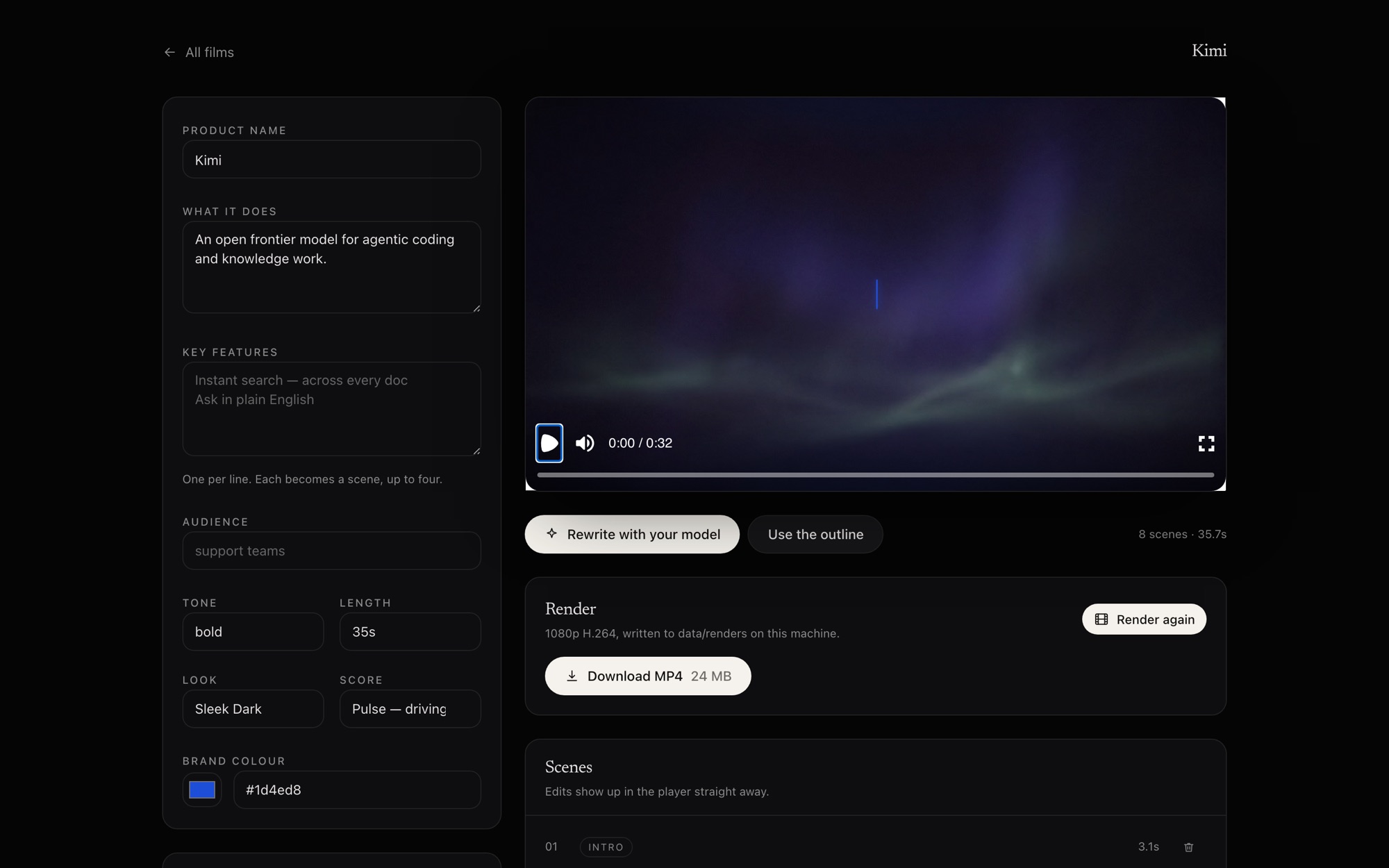
The flowy studio: a brief on the left, the animated film playing in the browser on the right, and a render panel offering the finished MP4
The player is the real composition, fully animated. Edit a scene and it changes in front of you — the MP4 is the same thing, encoded.

Describe a product, drop in a few screenshots, and flowy writes the script against your own model, animates it into a beat-locked motion-graphics film, and renders the 1080p MP4 locally. The score is original and composed offline, and the film's beat grid is derived from the track, so every cut lands on the music rather than near it. No account, no credits, and nothing that counts your exported minutes.

Why it works

The export is the point

Clueso's cheapest paid tier is six hours of video exports a year, and its free tier is ten minutes and seven days. flowy writes an MP4 to a folder. There is no minute to count, so nothing counts it.

Two ways to get a script, and you always know which

Your model writes it, or a deterministic outline builds one from the brief with no model at all. The app it grew from silently swapped in the template whenever the model call failed — you got a worse script and no way to tell. Here the failure is shown and the outline is a button you press on purpose.

The model never picks the timing

Scene durations are computed in code from the narration, then quantised onto the beat grid of the track. A language model asked for frame counts returns a film that is eight seconds or four minutes long, depending on its mood.

It renders where you are

The original exported through Remotion Lambda: an AWS account, a deployed function, a bucket, four environment variables and a per-render cost. All of it existed to make export worth charging for. This is `@remotion/renderer` in the same process.
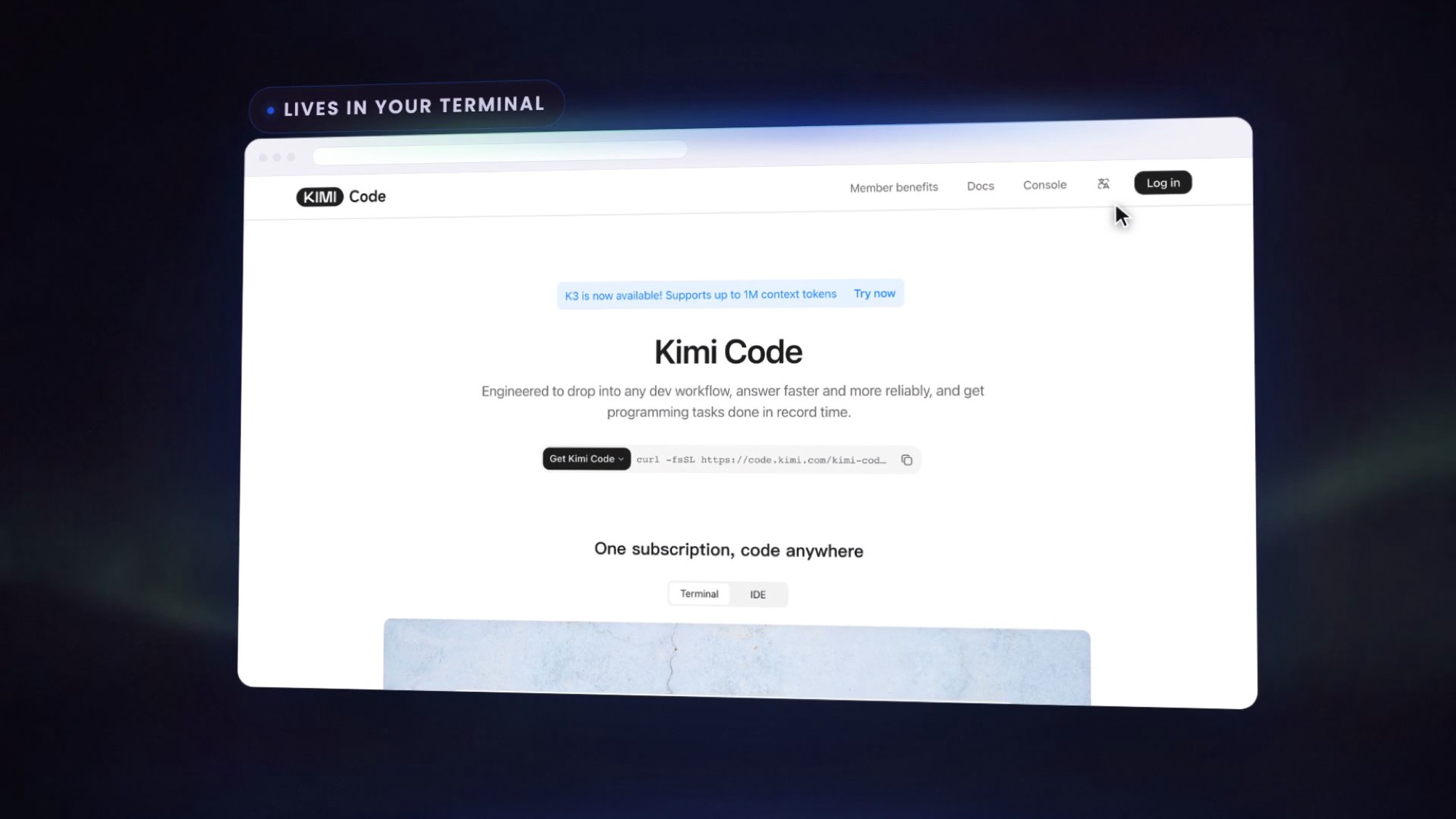

A frame from a rendered film: a product screenshot in a browser frame, tilted in 3D, under a small capsule reading LIVES IN YOUR TERMINAL
Your screenshots do the work, in browser frames the camera moves around. The type is Poppins, embedded in the bundle rather than fetched.
A frame from a rendered film: the figure 1M in large white type above a capsule reading tokens of context
One of nine board kinds. The cut onto the number is placed on a beat of the track that is playing under it.
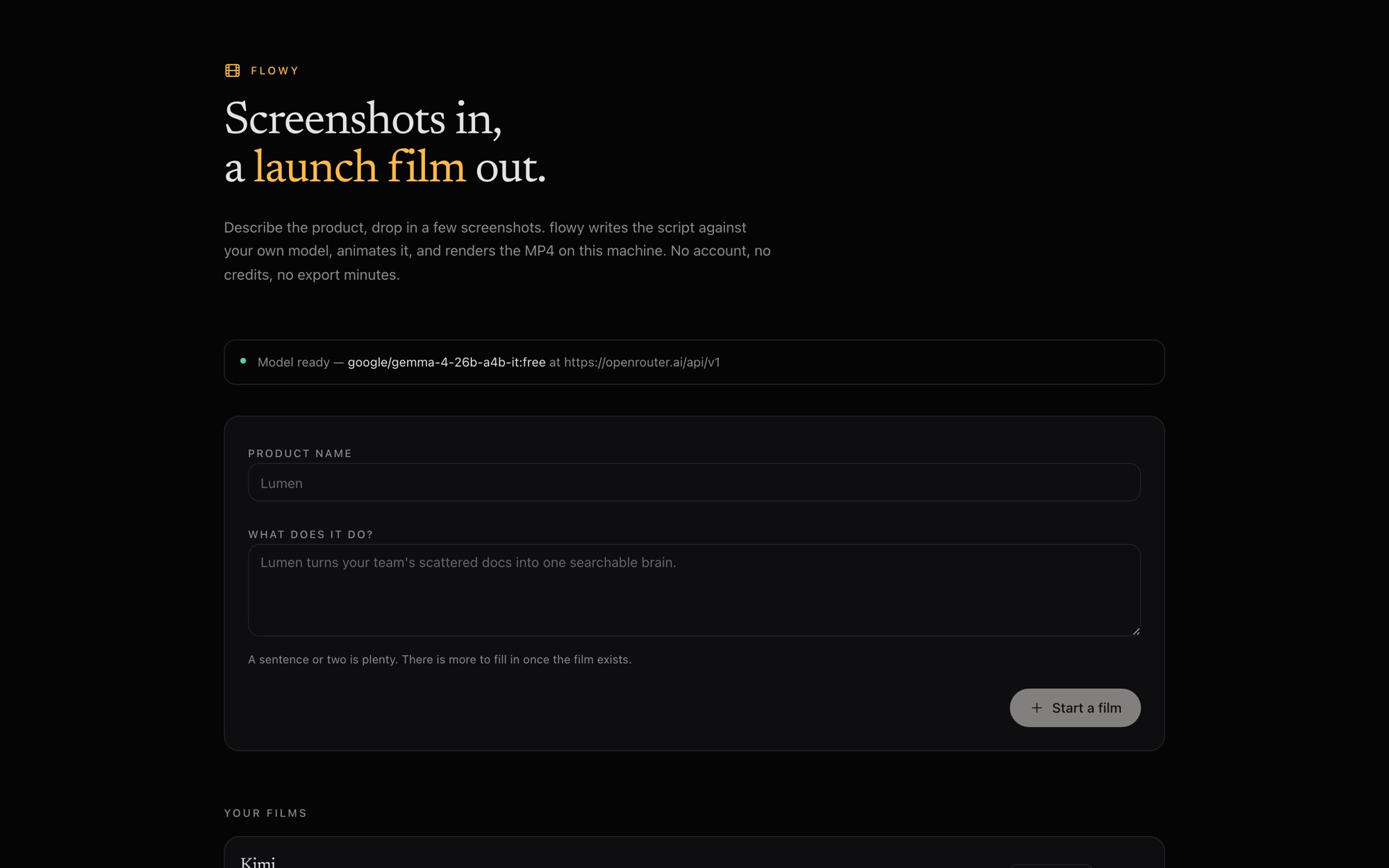
The flowy home screen: a form asking for a product name and what it does, above a list of films
The whole app. There is no sign-in, because there is nothing to sign in to.

Run it

shell
git clone https://github.com/openwarehq/flowy
cd flowy
docker compose up

Then open the app and connect a model — pick a provider, paste a free key, done. It also reads a repo-root .env if you prefer a file.

Measured

Tests green
76
32.6s film, native
83s
Same film, in Docker
195s
Dependencies
8, from 38

What it doesn’t do

Stated up front, because scope discovered at 2am is a betrayal.

  • The render engine is Remotion, which is source-available and not MIT. Free for individuals and for-profit companies up to three employees; larger for-profits need a company licence. flowy's own code is MIT — the engine under it is not, and this is the one drop here with a pricing page still underneath it.
  • 16:9 only. No vertical and no square: the board grammar is composed for a wide frame.
  • It does not record your screen. You bring screenshots and it makes motion graphics out of them.
  • No narration. Films are scored, not spoken — the timing machinery for voiceover is there and nothing in the drop produces the audio.
  • Rendering is slower in Docker than you will expect: a 32.6-second film took 83 seconds natively and 195 in the container, on the same machine.
  • The three background worlds and the stock stills are fixed assets. It composes and scores your film; it does not generate new footage.
  • One render at a time, and a restart loses the one in flight — the queue lives in the web process, because a queue that needs its own service is a second command.