The model never writes a timestamp
Transcript lines are numbered and the model returns line ids; TypeScript turns those into times. A model that cannot invent a number cannot hand you a clip that starts mid-word.
A long video in, ranked vertical shorts out — with the score explained.
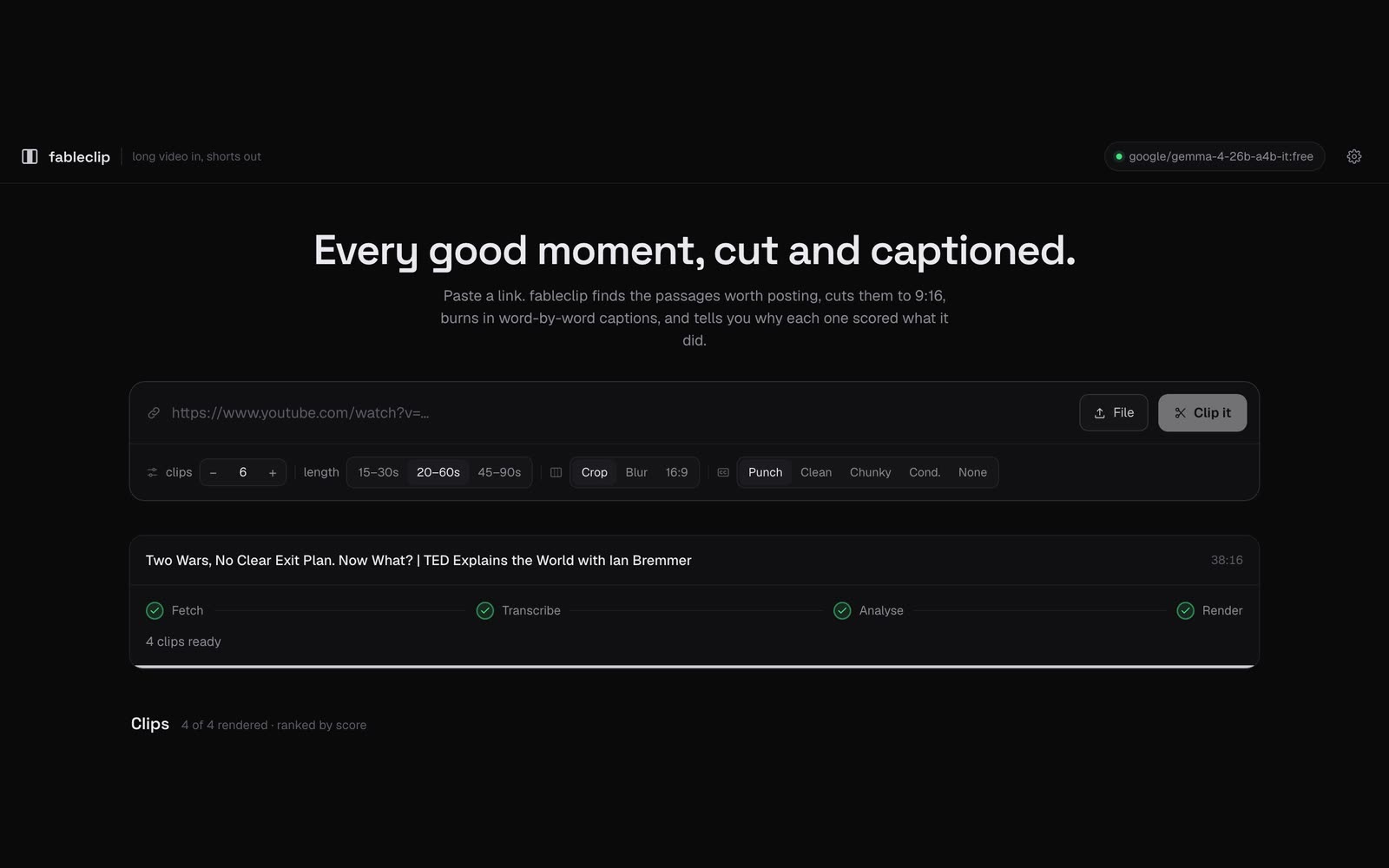
Paste a long video and get vertical, captioned shorts back, ranked by how likely each is to travel and told in plain numbers why. The model never writes a timestamp: transcript lines are numbered, it returns line ids, and TypeScript does the arithmetic. Every contribution to the 0–100 score is shown on the card.
Transcript lines are numbered and the model returns line ids; TypeScript turns those into times. A model that cannot invent a number cannot hand you a clip that starts mid-word.
Six 0–10 judgements weighted in code, plus modifiers measured from the transcript. Every contribution is shown on the card, so a ranking you disagree with tells you exactly which part to argue with.
YouTube's machine captions carry per-word tOffsetMs — creator-uploaded tracks do not, so the machine track is preferred over the human one. That is a word-accurate caption timing for nothing.
96×54 greyscale samples, columns scored on motion and detail. It picked the speaker out of a side-by-side Zoom two-shot where a centre crop lands on the seam.
git clone https://github.com/openwarehq/fableclip
cd fableclip
docker compose up
Then open the app and connect a model — pick a provider, paste a free key, done. It also reads a repo-root .env if you prefer a file.
Stated up front, because scope discovered at 2am is a betrayal.